

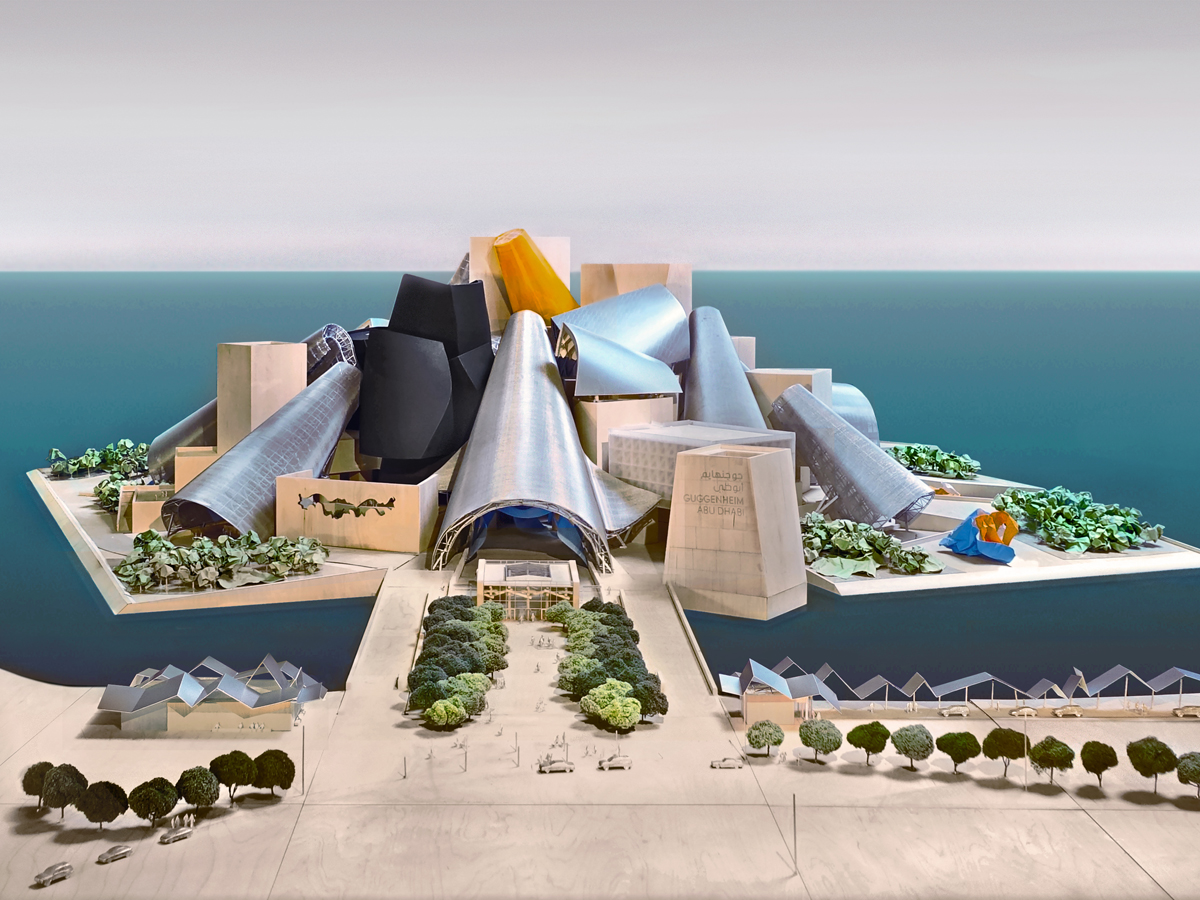
The long-delayed Guggenheim Abu Dhabi is nearing completion and is expected to open later in 2026, according to a senior UAE official, marking a major step in Abu Dhabi’s push to position itself as a global cultural hub.
Anwar Gargash, diplomatic adviser to UAE President Sheikh Mohamed bin Zayed Al Nahyan, said this month that the project is “nearing completion,” adding that “comprehensive development cannot be complete without the cultural component.” While authorities have not announced a specific opening date, the update signals progress on one of the capital’s most high-profile cultural developments.
Designed by Pritzker Prize-winning architect Frank Gehry, the museum anchors the Saadiyat Cultural District on Saadiyat Island. Gehry’s design features asymmetrical cone-shaped structures inspired by traditional Gulf wind towers. The building will span roughly 80,000 square meters, making it the largest museum in the Guggenheim network.
Plans call for 30 galleries offering 11,600 square meters of interior exhibition space, along with 23,000 square meters of outdoor display areas across plazas and terraces. The complex will also house a center for art and technology, an education facility, archives, a library and a conservation laboratory.
The museum will focus on modern and contemporary art from the 1960s to the present. Organizers say the collection includes more than 970 works by 429 artists from over 70 countries, with an emphasis on West Asia and surrounding regions. Curators have spent nearly two decades assembling the holdings.
The Guggenheim Abu Dhabi forms part of a broader cultural strategy on Saadiyat Island. The district already includes the Louvre Abu Dhabi and the Abrahamic Family House, while the Zayed National Museum and the Natural History Museum Abu Dhabi are scheduled to open in 2025.
The project is a collaboration between Abu Dhabi’s Department of Culture and Tourism and the Solomon R. Guggenheim Foundation, which operates museums in New York, Venice and Bilbao.
For Abu Dhabi, the museum represents more than an architectural landmark. The emirate has invested heavily in culture and tourism as part of efforts to diversify its economy beyond oil and attract international visitors and talent. If the Guggenheim opens as planned in 2026, it will add another globally recognized institution to the UAE’s growing cultural portfolio — and test whether sustained investment in the arts can translate into long-term economic and soft-power gains.
