

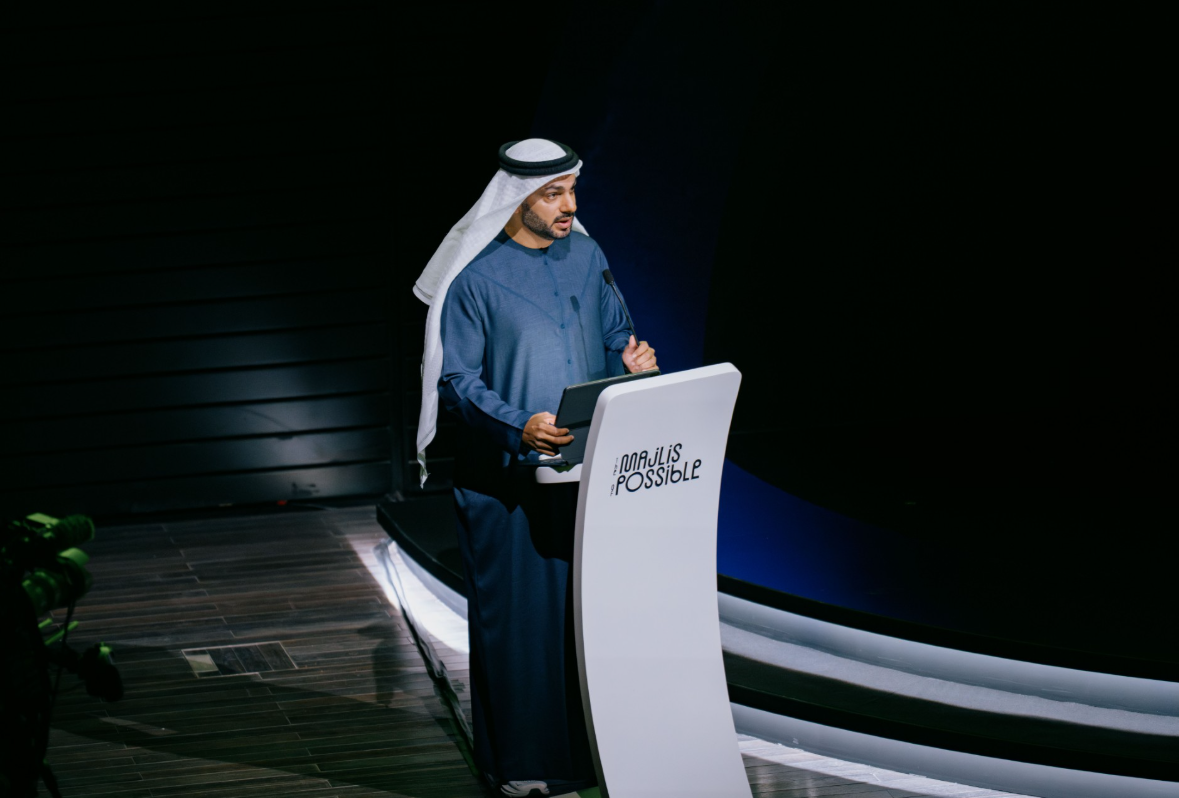
Senior leaders from government, technology, and business gathered at The Majlis of Possible to examine how artificial intelligence (AI) and connected systems are reshaping economic and organizational models in the region. The forum, hosted by Publicis Groupe Middle East on 12 February at Louvre Abu Dhabi, brought together executives from G42, Publicis Sapient, Microsoft, Snapchat, Nestlé, Amazon Ads, and Adobe. Policymakers and institutional leaders also participated.
The discussions focused on institutional readiness rather than emerging tools. Specifically, participants explored how governments and enterprises can build governance structures, operating disciplines, and reliable data foundations. These elements are essential to deploy AI successfully at scale.
The forum’s headline AI session featured H.E. Mansoor Al Mansoori, Nigel Vaz, Global CEO of Publicis Sapient, and Samer Abu-Ltaif, President of Microsoft Middle East and Africa. Becky Anderson moderated the conversation. The panel agreed that while advanced technology is widely available, execution remains the key differentiator.
Al Mansoori emphasized the difference between consumer-facing applications and enterprise systems. He explained that AI strengthens capabilities where systems are mature but exposes weaknesses where they are not. Similarly, Vaz said boards are moving beyond defining AI. Instead, they focus on understanding how AI creates measurable value. Meanwhile, Abu-Ltaif highlighted the importance of trust, governance, and sovereignty. He added that training programs must align with institutional frameworks, controls, and regulations.
Additionally, sessions under the “Economy of the Possible” banner examined how organizations respond to volatility, shifting consumer behavior, and regulatory changes. Speakers argued that intelligence infrastructure is a foundation for competitiveness rather than a standalone investment. Moreover, panels explored how culture, sport, luxury, and tourism contribute to future growth, reflecting the region’s diversified economic priorities.
The forum opened with remarks from H.E. Saood Abdulaziz Al Hosani, Undersecretary of the Department of Culture and Tourism, who highlighted Abu Dhabi’s role as a hub for innovation. Furthermore, H.E. Nicolas Niemtchinow, France’s Ambassador to the UAE, spoke on France-UAE cooperation and cross-border partnerships.
A parallel “Studio of the Possible” program engaged students and young professionals. Organizers said this initiative underscores the need for talent development alongside technological investment. They also stressed that collaboration across policy, business, and technology communities is crucial for successful AI implementation.
In conclusion, participants agreed that AI is no longer a future goal—it is an operational reality. They noted that institutions will benefit most when they align strategy, governance, and leadership to embed intelligent systems into everyday decision-making.
