

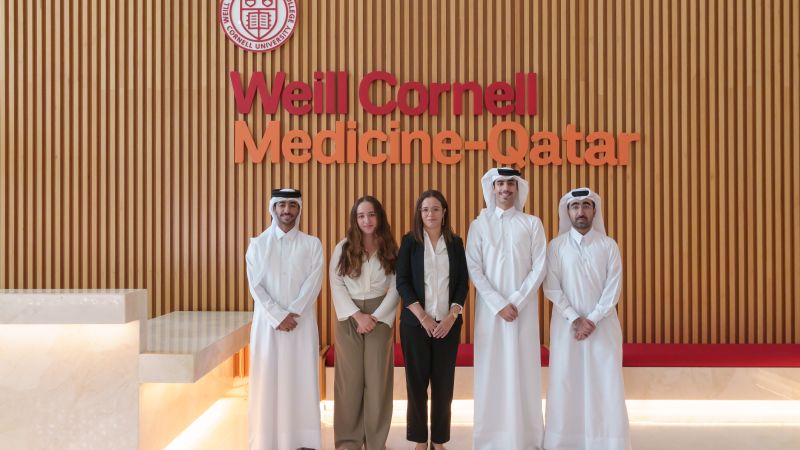
Four students from Weill Cornell Medicine–Qatar (WCM-Q) have co-authored a paper proposing innovative microbiome-based strategies to help combat the growing global threat of antimicrobial resistance (AMR).
The perspective paper, published in Frontiers in Microbiomes, highlights natural methods of boosting microbial diversity as a way to reduce dependency on antibiotics.
The student co-authors — Ali Al-Kuwari, Hamad Al-Karbi, and Abdulla Al-Khuzaei, all from the Class of 2029, along with Dounia Baroudi from the Class of 2030 — were guided by Dr Ghizlane Bendriss, assistant professor of biology at WCM-Q, who is the lead author of the study.
The research was conducted in response to discussions at the World Innovation Summit for Health (WISH) 2024, where tackling AMR was emphasised as a national priority.
Tackling a growing crisis
AMR occurs when bacteria evolve to withstand medicines designed to kill them, rendering treatments ineffective. The issue has been driven largely by the overuse of antibiotics worldwide.
The paper stresses that restoring and maintaining microbial balance in the gut could provide sustainable alternatives to pharmaceutical interventions. Strategies include changes in diet, the use of probiotics, faecal microbiota transplantation (FMT), and fermentation of animal and plant products.
One experiment cited in the paper found that fermenting camel milk increased microbial diversity, improved resilience of the microbiome, and may reduce resistance to widely used antibiotics such as tetracycline, streptomycin, penicillin and chloramphenicol.
“Over the past four decades, antibiotic innovation has declined sharply,” Dr Bendriss said. “We need to completely shift our strategy. Microbes already fight one another naturally, and an enriched gut environment prevents resistant strains from dominating. Microbiome-based solutions such as probiotics or FMT may offer the most sustainable path forward.”
Student perspectives
The students involved described the project as both academically challenging and personally rewarding.
“Working alongside my peers under the guidance of Dr Bendriss has been an incredible opportunity,” said Al-Kuwari. “It deepened my understanding of the microbial world and the potential of microbiome-based approaches in tackling health challenges.”
Baroudi said she was intrigued by the role of fermented foods in supporting microbial health. “I realised that fighting harmful bacteria isn’t just about more antibiotics — it’s about restoring balance and nurturing microbial ecosystems,” she said.
Looking ahead
The paper also outlines a mechanistic model demonstrating how maintaining microbial diversity can curb resistant strains and support long-term health.
However, the authors emphasised that more research is needed to fully understand the mechanisms and broader public health implications.
The study was supported by funding from WCM-Q’s pre-medical department.
The full paper, Beyond antibiotics: leveraging microbiome diversity to combat antimicrobial resistance, is available via Frontiers in Microbiomes.
