

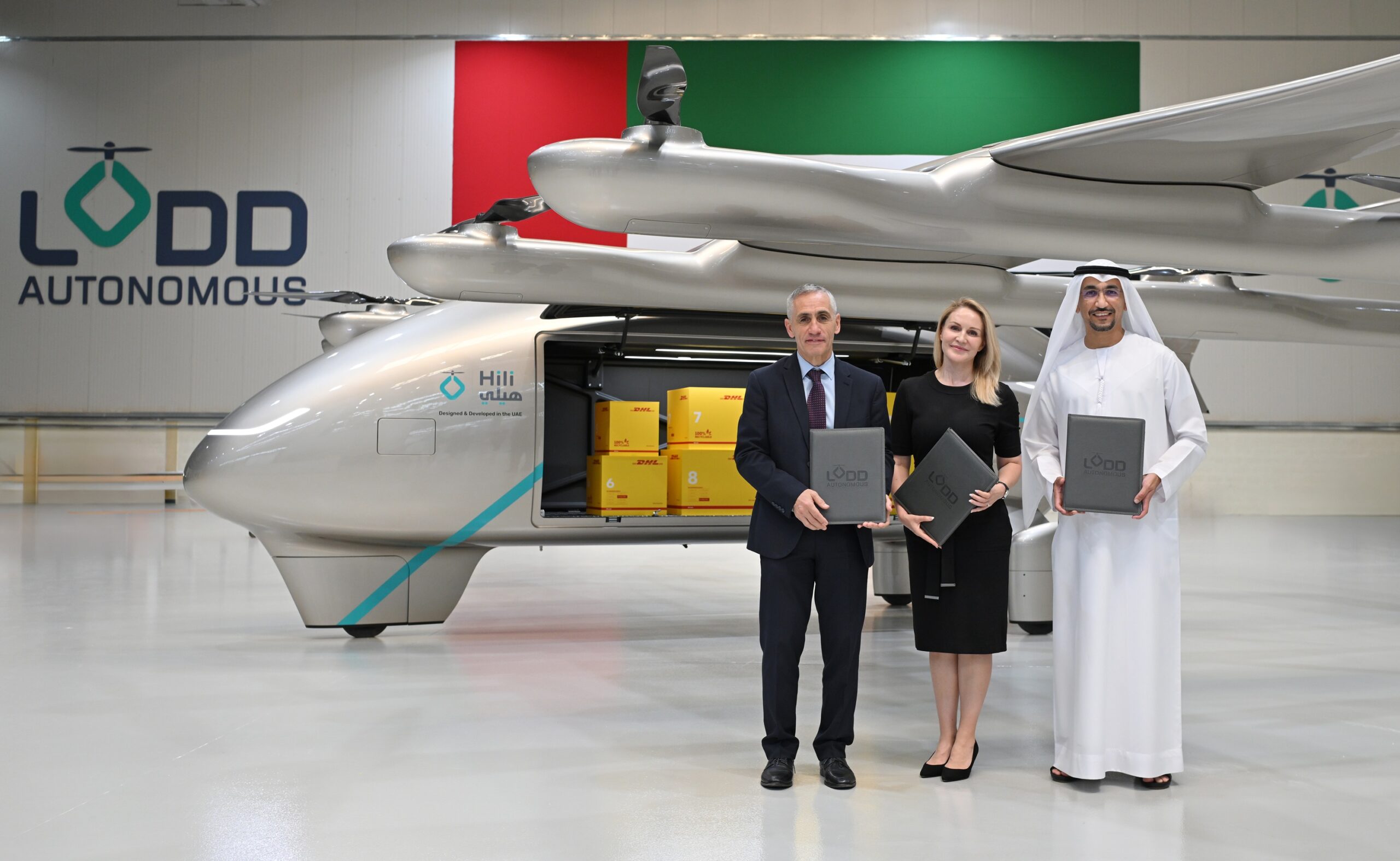
DHL Express has signed a memorandum of understanding with Abu Dhabi-based LODD Autonomous to explore integrating unmanned cargo aircraft into its delivery network in the UAE, as logistics firms seek alternatives to road transport in congested urban areas.
Announced on Monday in Abu Dhabi, the agreement will see both companies begin operational workshops to identify potential routes and use cases for LODD’s “Hili” unmanned aircraft. The discussions will focus on route planning, payload configuration, turnaround times and how the aircraft could connect with DHL’s existing ground and air infrastructure.
Bachi Spiga, DHL Express’s vice president for network operations in the Middle East and North Africa, said congestion in fast-growing markets such as the UAE is prompting the company to assess new delivery models. “Speed and reliability are essential,” he said, adding that unmanned aircraft could offer a “sustainable way forward” to meet rising demand.
LODD, founded in 2023, is developing autonomous aircraft designed for cargo transport across urban and regional routes. Its Hili model has a maximum payload of 250 kilograms — equivalent to two Euro pallets — and features vertical take-off and landing capability. The aircraft can travel up to 700 kilometres with reserve capacity and operate at altitudes of up to 14,000 feet, according to the company.
Chief executive Rashid Al Manai said the collaboration would concentrate on ensuring “safe, reliable, and scalable deployment” if the aircraft moves beyond the testing phase.
The partnership reflects a broader push within the UAE to position itself as a hub for advanced air mobility and smart logistics. Regulators in the region have signalled support for trials involving autonomous aerial systems, while transport operators face mounting pressure to reduce delivery times and emissions in dense city environments.

For DHL Express, which has operated in the UAE for five decades, the initiative represents a potential addition to a network that already includes around 40 facilities and more than 150 daily flight connections from the country. The company runs over 350 vehicles locally and relies on both commercial and dedicated aircraft to move shipments through its regional hubs.
Industry analysts say unmanned cargo aircraft could complement traditional logistics networks by serving remote areas or bypassing traffic bottlenecks, though widespread adoption will depend on regulatory approvals, airspace management systems and cost efficiency.
The MoU does not commit either party to a full rollout, but it signals growing interest among major logistics providers in testing autonomous solutions that could reshape last- and middle-mile delivery in the years ahead.
