

Google’s latest artificial intelligence tool, Gemini Nano Banana, is being hailed as a breakthrough in image editing—but not everyone is celebrating. While the model has impressed technologists with its ability to outperform rivals such as OpenAI’s ChatGPT and Elon Musk’s Grok, it has also triggered a new wave of anxiety among artists worldwide.
The clash between AI innovation and creative industries is long-standing. Yet, Nano Banana’s capabilities—such as generating base sketches, building comic panels in specific styles, and producing poses and reactions from a single illustration—have intensified the debate. Many fear that the technology will further blur the line between human creativity and machine-driven replication.
Artists voice alarm
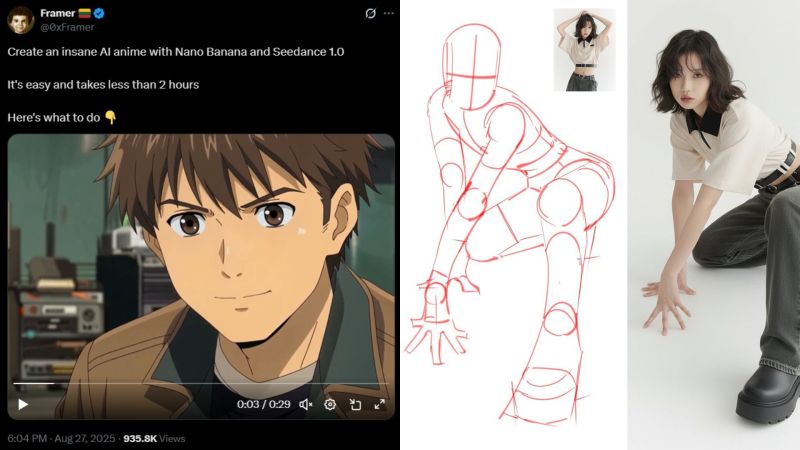
Almost immediately after its announcement, users on social media platforms like X (formerly Twitter) began sharing examples of Nano Banana’s potential. A self-described AI “artist” named “-Zho-” demonstrated the tool by taking a sketch from Pinterest and generating a realistic image of an Asian woman. While the results were strikingly accurate, flaws remained in details such as face angles and body poses.
Nevertheless, artists argue that the demonstration highlights an ongoing problem: AI systems rely on vast datasets of human-made art—often without the creators’ knowledge or permission. Many view this as digital appropriation that undercuts years of training and study.
Why the backlash is growing
For creatives, the stakes are more than philosophical. Across industries such as gaming, film, and animation, cost-cutting measures are already driving companies to explore AI as an alternative to employing traditional artists. With widespread layoffs hitting creative sectors, the fear of being replaced by algorithms has become palpable.
“Artists spend years refining skills like anatomy, perspective, and visual storytelling. Having that work fed into a machine without consent feels like theft,” one illustrator commented in a widely shared post. Others described the rise of AI art tools as “a spit in the face” to human effort.
Critics also argue that AI tools create the illusion of originality while being wholly dependent on the collective labour of artists worldwide. In their view, AI does not innovate; it imitates.
Tech enthusiasts push back
Supporters of AI counter that tools like Nano Banana democratise creativity by making professional-level editing and design accessible to anyone. Some argue that, rather than replacing artists, such models will become assistive technologies—speeding up workflows, experimenting with styles, and offering new creative directions.
But for now, the release of Google’s Nano Banana has sharpened divisions between those excited by its technical possibilities and those fearful of its ethical implications.
What remains clear is that the debate over AI’s role in art is far from over—and with each new breakthrough, the conversation only grows louder.
